Couldn't load pickup availability
CarbonMedical
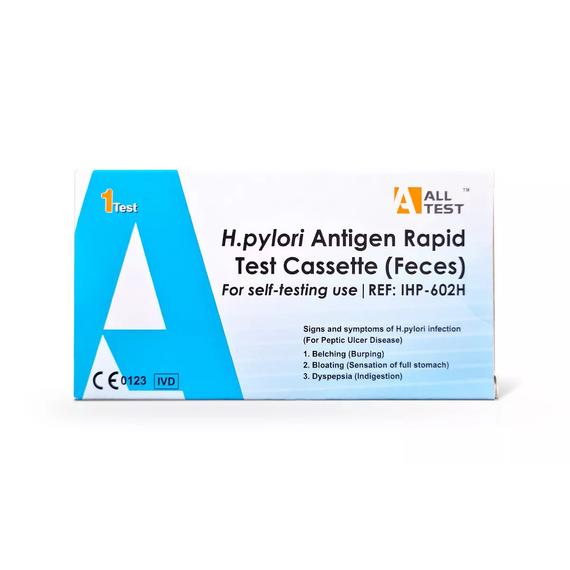
Alltest Helicobacter Pylori Rapid Test for Home Use (Stool Sample) (1 pc/box)
Alltest Helicobacter Pylori Rapid Test for Home Use (Stool Sample) (1 pc/box)
• The price includes 5% VAT.
In accordance with the applicable legislation, Carbon Web Kft. may sell IVD tests intended for self-testing online to private individuals in accordance with Decree No. 7/2004 (XI. 23.) of the Minister of Health, and may have them delivered to the customer’s home by parcel delivery after the order has been placed. Please note that by placing your order you waive your right to be provided with professional information on the use of the self-test. For correct performance of the test, we enclose detailed instructions for use in Hungarian, which you will find in the test box and on our website.
Helicobacter Pylori Rapid Test
Helicobacter pylori is a bacterium that lives as a parasite in the human stomach. This bacterium is responsible for the development of most gastric ulcers and gastritis.
The Helicobacter pylori rapid test is a diagnostic device that helps detect the presence of the bacterium in a stool sample. The test provides a quick and simple procedure for diagnosing the infection.
The Helicobacter pylori bacterium is responsible for numerous digestive tract diseases. The most common diseases that Helicobacter pylori can cause are the following:
- Gastric ulcer: In the long term, Helicobacter pylori infection can lead to gastric ulcer, which results in ulceration of the stomach wall.
- Duodenal ulcer: The bacterium can also cause duodenal ulcer, which results in ulceration of the duodenal wall. This infection most often develops in the first part of the duodenum.
- Gastritis (inflammation of the gastric mucosa): In the long term, Helicobacter pylori infection can lead to gastritis, which results in inflammation of the lining of the stomach.
- Gastric cancer: Persistent Helicobacter pylori infection increases the risk of developing gastric cancer. The long-term presence of the bacterium can cause irritation and inflammation in the stomach, which may contribute to the development of cancer cells.
- MALT lymphoma: Helicobacter pylori infection can sometimes lead to MALT (mucosa-associated lymphoid tissue) lymphoma. This is a rare type of lymphoma that develops in mucosa-associated lymphoid tissues.
It is important to note that the Helicobacter pylori bacterium may be present in many people without causing disease. However, in some individuals this bacterium can cause the digestive tract diseases mentioned above. The exact risk and the likelihood of developing these diseases depend on individual factors, such as the state of the individual’s immune system, genetic predisposition and other environmental factors.
The Alltest Helicobacter Pylori rapid test is designed for home use.
Helicobacter Pylori Rapid Test Specification
Product name: Alltest Helicobacter Pylori Rapid Test for Home Use
Sample: stool
Pack size: 1 pc/box
Format: cassette test
Manufacturer: Hangzhou Alltest Biotech Co., Ltd., Ltd., 550 Yinhai Street, Hangzhou Economic and Technologic Development Area, 310018, Zhejiang, China; Telephone: +86-571-56267891; info@alltests.com.cn
EC REP: MedNet GmbH, Hansestraße 91, 48165 Münster, Germany; +49 251 32266-0; info@medneteurope.com
Expiry date: 31/07/2028
Contents of the Helicobacter Pylori Rapid Test Kit
- 1 test cassette
- 1 sample collection tube with extraction buffer
- 1 stool collection paper
- 1 set of instructions for use in Hungarian
Test Procedure
Read the Instructions for Use carefully before performing the test! Before performing the test, a stool sample must be collected according to the instructions for use.
1. Wash your hands with soap and rinse them with clean warm water.
2. Collecting stool samples:
The stool sample must be collected onto the stool collection paper or into a clean collection container. Please use the stool collection paper and avoid contamination of the sample by taking precautions so that the sample, or the side of the paper containing the sample, does not come into contact with any contaminating objects, including toilet cleaning agents.
3. Processing stool samples:
Unscrew the cap of the sample collection tube, then randomly stab the sample collection applicator into the stool sample at at least 3 different sites. Do not scoop the stool sample.
Tighten the cap onto the sample collection tube, then shake the sample collection tube vigorously to mix the sample with the extraction buffer.
4. Before opening, bring the pouch to room temperature. Remove the test cassette from the foil pouch and use it as soon as possible. The best results are obtained if the test is performed immediately after opening the foil pouch.
5. Open the cap of the sample collection tube and break off its tip. Invert the sample collection tube and transfer 2 full drops of the extracted sample into the sample well (S) of the test cassette, then start the timer. Take care that no air bubbles are trapped in the sample well (S).
6. Read the results after 10 minutes. Do not wait more than 20 minutes to read the result under any circumstances.
Interpretation of Results
Positive
Two colored lines appear. Both the (T) test line and the (C) control line appear. This result means that H. pylori antigen is present in the stool and you must consult a doctor. *NOTE: The intensity of the color in the test line region (T) will vary depending on the concentration of H. pylori antigens in the sample. Therefore, any shade of color in the test line region (T) should be considered positive.
Negative
One colored line appears. Only the control line (C) appears. No line appears in the test line region (T). This result means that the presence of H. pylori antigen in the stool could not be detected.
Invalid
The control line does not appear. The most likely reasons for the absence of the control line are insufficient sample volume or incorrect procedural technique. Review the procedure again and repeat the test using a new test. If the problem persists, discontinue use of the test kit and contact your local distributor.
Reliability of the Helicobacter Pylori Rapid Test
The H. pylori Antigen Rapid Test Cassette (Stool) was evaluated on samples from symptomatic and asymptomatic individuals. The results show that the sensitivity of the H. pylori Antigen Rapid Test Cassette (Stool) is 97.6% and its specificity is 97.9% compared to another rapid test. Overall accuracy: 97.8%.
Instructions for use